Science & Technology | GS II
Current Affairs
26 October 2026 5 min read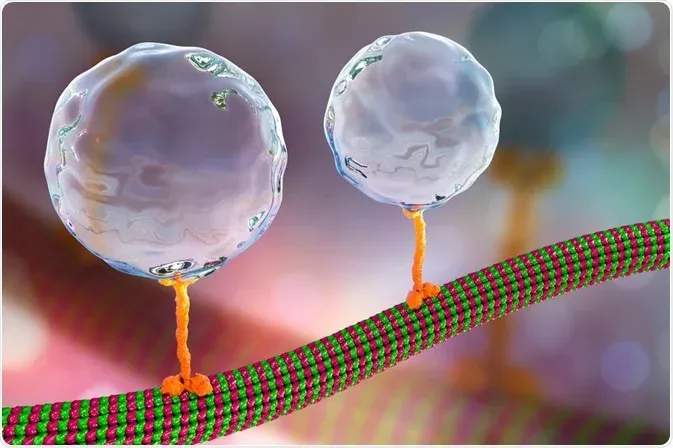
Researchers reported a light- and electricity-responsive molecular machine, adding to advances in the design of artificial systems that convert energy into controlled molecular motion.
What are molecular machines?
- Molecular machines are molecules or molecular assemblies that use energy to produce controlled movement and perform specific tasks.
- They operate at the molecular scale, where thermal motion constantly disturbs their structure.
- Examples in nature include:
- Kinesin: A motor protein that transports cellular cargo along microtubules.
- Myosin: A motor protein involved in muscle contraction.
- ATP synthase: A molecular machine that uses a proton gradient to produce ATP, the cell's energy currency.
- Artificial molecular machines are designed to reproduce or exploit such movement for specific purposes.
- The scientists who worked for the design and synthesis of molecular machines received the 2016 Nobel Prize in Chemistry.
- Jean-Pierre Sauvage: Connected ring-shaped molecules to create mechanically interlocked structures.
- Fraser Stoddart: Developed molecular systems in which a ring could move along a molecular axle.
- Ben Feringa: Developed molecular motors driven by light.
- Applications:
- Medicine: Molecular systems could eventually help deliver drugs or respond to specific biological conditions.
- Nanotechnology: Controlled molecular motion could support nanoscale devices and materials.
- Materials science: Molecular machines could enable materials whose properties change in response to light, heat or electrical signals.
- Chemical engineering: Molecular movement could potentially be used to control chemical processes.
- Sensors: Stimulus-responsive molecules could help detect and respond to particular chemical conditions.
How are molecular machines designed?
- Artificial molecular machines often use specially arranged molecular components that can move relative to one another.
- Ring-and-axle systems

- A ring-shaped molecule is threaded onto a molecular axle. The ring can move along the axle, similar to a wheel moving along a shaft.
- Scientists can control its position using chemical or other external stimuli.
- Light-driven molecular motors
- Light supplies energy that causes a molecule to change its shape or rotate in a preferred direction.
- This enables scientists to create molecular motors whose movement can be controlled by light.
- Electrically driven molecular machines
- A corkscrew-shaped molecular structure changes between different states when an electric current flows through it.
- Reversing the current reverses the sequence of states. This demonstrates how electrical energy can be used to control molecular motion.
How do molecular machines convert energy into motion?
- The basic principle is Energy input → change in molecular structure or energy state → controlled movement → mechanical task
- Depending on the design, the energy source can be:
- Light
- Chemical reactions
- Electrical energy
- Unlike ordinary machines, molecular machines must operate amid constant thermal fluctuations. Their design must therefore make useful movement sufficiently controlled and repeatable.
Why are molecular machines difficult to control?
- Thermal fluctuations: At the molecular scale, random thermal motion can disturb molecular structures and make movement unpredictable.
- Brownian motion: Molecules are constantly buffeted by surrounding molecules. This random motion can interfere with the intended movement of a molecular machine.
- Directional control: A molecular machine must be designed to produce useful movement rather than simply changing shape randomly.
- Coordination: Combining several molecular machines into a system is difficult because their movements must be coordinated.
- Durability and control: Researchers must establish whether molecular machines can operate repeatedly and reliably under practical conditions.
Conclusion:
Molecular machines could expand nanotechnology by enabling controlled movement at the smallest scales, provided scientists can make their operation reliable, repeatable, and scalable.
#Kinesin
#Myosin
#ATP synthase