Disaster Management | GS III
Current Affairs
26 September 2026 5 min read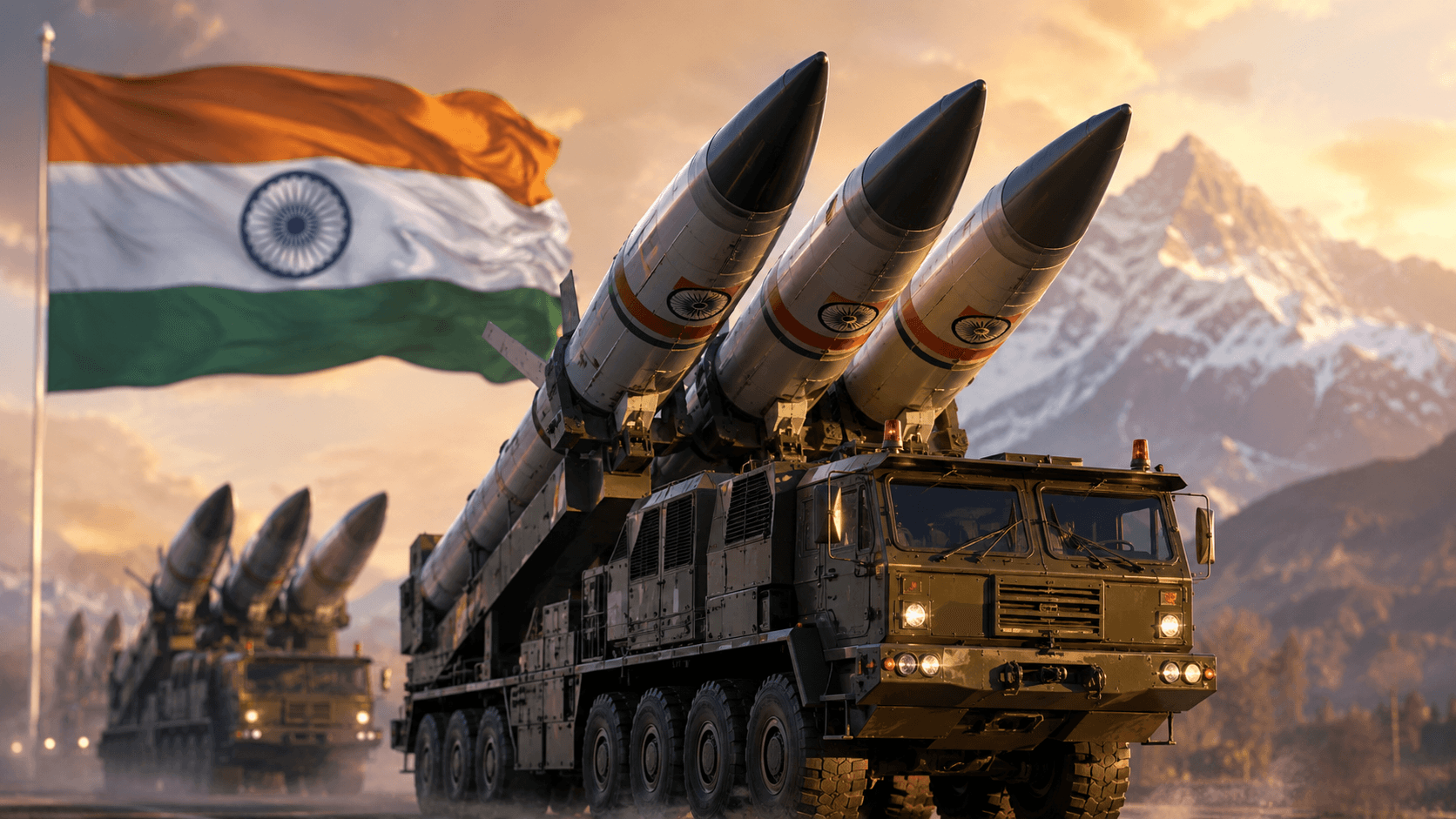
India’s nuclear doctrine has remained broadly unchanged for more than two decades, while the strategic environment around India has undergone significant changes.
What are the foundations of India’s nuclear doctrine?
- In 1998 India conducted the Pokhran-II nuclear tests, establishing India as a nuclear-armed state.
- 1999 Draft Nuclear Doctrine provided the initial framework for nuclear deterrence.
- 2003 Cabinet Committee on Security decision operationalised the doctrine and established the framework:
- Credible Minimum Deterrence: maintain only the nuclear capability necessary to deter nuclear attack.
- No First Use: India commits not to use nuclear weapons first.
- Massive retaliation: nuclear retaliation following a nuclear attack is intended to impose unacceptable costs on the adversary.
- Civilian control: nuclear weapons remain under political authority.
- Second-strike capability: forces must survive an initial attack sufficiently to enable retaliation.
What has changed since the doctrine was formulated?
Strategic shift
- China has:
- Expanded and modernised its nuclear forces
- Strengthened military infrastructure along the Line of Actual Control
- Deepened defence cooperation with Pakistan
- Pakistan has:
- Diversified its nuclear capabilities
- Developed tactical nuclear weapons
- Sought to offset India's conventional military advantage
Result:
- The original India-China and India-Pakistan strategic problems have become increasingly interconnected.
- India therefore has to consider the possibility of facing two closely aligned nuclear adversaries during a crisis.
Technological shift
- New technologies are changing the nuclear-deterrence environment.
- Important developments include:
- Artificial Intelligence
- Cyber capabilities
- Space-based surveillance
- Hypersonic weapons
- Ballistic missile defence
- These technologies can shorten decision-making timelines and increase the vulnerability of:
- Command-and-control systems
- Communication networks
- Early-warning systems
- Nuclear delivery systems
Key implication
- The fundamental principles of deterrence do not necessarily become irrelevant.
- Rather, the technological environment in which those principles operate has changed.
Geopolitical shift
- The Indo-Pacific has become a major arena of great-power competition.
- At the same time
- U.S.-China rivalry has intensified.
- China-Russia coordination has increased.
- India's strategic partnerships have expanded.
- The international system has become more multipolar.
- Therefore, India's nuclear doctrine cannot be understood solely through the traditional India-Pakistan bilateral deterrence framework.
Why should India be cautious about changing the doctrine?
- India's nuclear doctrine has contributed to its image as a restrained and responsible nuclear power.
- Ambiguity around established principles, particularly NFU, could create uncertainty.
- Uncertainty could encourage adversaries to recalibrate their strategies.
- It could also complicate crisis management.
Conclusion:
India's nuclear doctrine need not be treated as either immutable or disposable. A periodic review can preserve its core principles while ensuring that survivability, command and control, early warning and second-strike capabilities remain credible in a changing strategic and technological environment.
#Pokhran-II nuclear
#Cyber capabilities