Economy | GS III
Current Affairs
19 September 2026 5 min read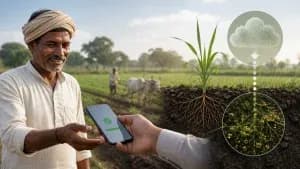
For the first time in India, farmers are receiving direct payments for carbon stored in their soil. More than 2,500 farmers in Punjab and Haryana are set to receive over ₹2.9 crore through the Aadi farmer carbon programme.

What is soil carbon?
- Soil carbon refers to carbon stored in soil organic matter through plant residues, roots and other organic materials.
- Agricultural practices can influence whether carbon is:
- stored in the soil, increasing soil organic carbon; or
- released into the atmosphere as greenhouse gases.
- This creates the basis for soil-carbon projects in agricultural carbon markets.
- Practices such as reduced tillage, residue management and diversified cropping can improve soil health and potentially increase carbon storage.
What is the Aadi Programme?

- Aadi is a farmer carbon programme launched by Grow Indigo in 2019, with technical guidance from ICAR.
- Farmers adopted regenerative farming practices during 2019–2022.
- The resulting reduction in greenhouse-gas emissions and increase in soil carbon were measured and independently verified.
- Carbon credits were then issued under the Verra VM0042 methodology.
- Farmers receive a share of the carbon credits generated from their own fields.
- Farming practices involved: The programme promotes practices such as:
- Direct Seeded Rice (DSR)
- Reduced/minimum tillage
- Crop-residue management
- Residue retention
- Diversified cropping
- Efficient water use

- How does soil carbon payment work?
The important feature is that farmers are not simply paid for adopting a practice.
They are paid based on the verified environmental outcome generated by their fields.
Farmers adopt regenerative practices
↓GHG reductions and soil-carbon changes are measured
↓Data are independently verified
↓Carbon credits are issued
↓Revenue from carbon credits is shared with participating farmers
This makes the initiative an example of results-based environmental payments.

Conclusion: Soil-carbon payments represent a shift from treating sustainability as an additional cost of farming to recognising it as a potential source of farm income. Their long-term success will depend on credible MRV, transparent benefit sharing and wider adoption of resource-efficient agriculture.