Economy | GS III
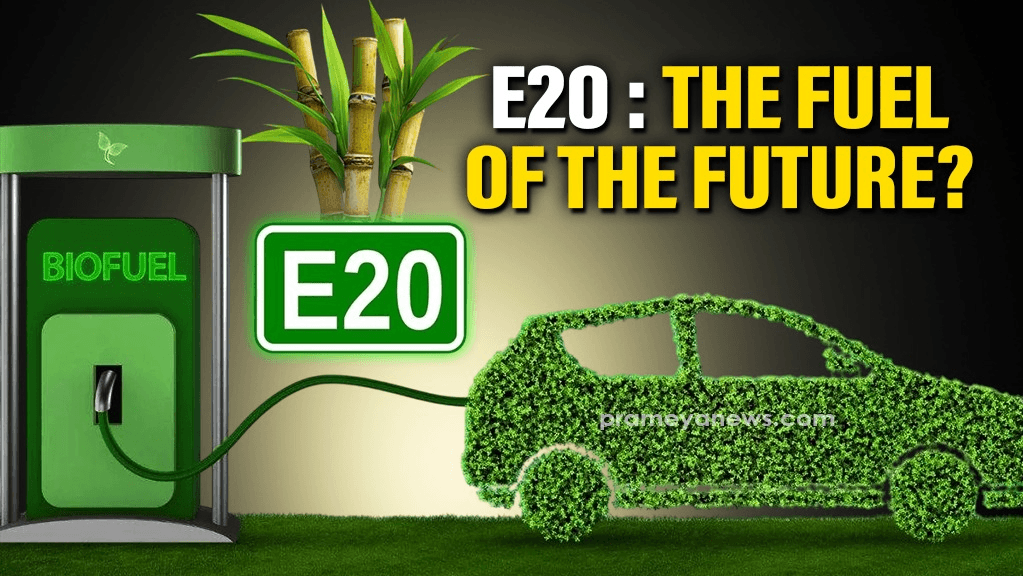
As the government notified that from April 1, 2026, petrol must be sold with up to 20% ethanol, with a minimum RON of 95, India has rapidly moved towards 20% ethanol blending in petrol (E20) as part of its strategy to reduce crude-oil import dependence, save foreign exchange and lower carbon emissions. The transition has generated concerns over mileage loss, mechanical wear, fuel contamination and compatibility of older vehicles.
What is the regulatory baseline for E20?
- E20: Petrol containing up to 20% ethanol.
- From April 1, 2026, fuel retailers were required to sell petrol blended with up to 20% ethanol.
- Earlier, automobile manufacturers were mandated to comply with Bharat Stage VI Phase 2 Real Driving Emission (RDE) norms from April 2023.
- Vehicles manufactured after April 2023 are therefore broadly designed with greater compatibility with higher ethanol blends.
- The major transition challenge concerns the large pre-April 2023 legacy fleet.
India’s vehicle fleet in transition

The transition is occurring while roughly 77% of the estimated fleet consists of legacy/non-compliant vehicles.
What makes ethanol different from conventional petrol?
- Ethanol is a powerful polar solvent and natural detergent.
- It is also hygroscopic, meaning it absorbs moisture from its surroundings.
- These properties create specific compatibility concerns in older fuel systems.
- Engineering implications:
- Ethanol can loosen rust, varnish and microscopic oxidised scales accumulated in older fuel systems.
- Dislodged particles can enter the fuel stream and clog fuel filters, pump strainers and injector nozzles.
- Ethanol's affinity for water can increase the risk of water absorption and phase separation.
- The resulting water-ethanol layer can create corrosion and damage fuel-system components.
- In older vehicles, conventional NBR rubber hoses, O-rings and diaphragms may be more vulnerable to ethanol exposure.
- Ethanol also contains roughly 30–35% less energy per unit volume than petrol, which can contribute to lower fuel economy.
What are the main concerns during the E20 transition?
- Mileage and consumer cost
- Lower energy content of ethanol can contribute to reduced mileage.
- The effect may be more significant for older vehicles.
- Legacy vehicle compatibility
- A large proportion of India's fleet predates E20-oriented engineering standards.
- Older fuel-system components may be more vulnerable to ethanol-related degradation.
- Fuel contamination: Water absorption and chemical contamination can increase risks of:
- Phase separation
- Corrosion
- Injector problems
- Fuel-pump damage
- Engine malfunction
- Information asymmetry: Consumers may not clearly know whether a particular vehicle is optimised for E20, E10 or lower blends.
- Evidence gap:
- The disagreement exists between laboratory findings, industry experience and consumer reports.
- This creates a need for independent, transparent and long-term empirical evidence
How can the E20 transition be made more consumer-centric?
- Clearer fuel choice and labelling
- Retail outlets should clearly indicate the ethanol blend level.
- Retain E0/unblended petrol or a lower-blend option as a consumer choice, particularly for owners of legacy vehicles.
- Strengthen fuel-quality monitoring
- Regular batch-level quality testing should be published by oil marketing companies.
- Monitoring should specifically cover:
- Develop and certify:
- Ethanol-resistant fuel lines
- Reinforced seals
- Compatible fuel-system components
- Such upgrades can reduce risks for older vehicles.
- Independent real-world testing
- Conduct multi-year, transparent field studies across different vehicle ages, regions and climatic conditions.
- This can help resolve the divergence between laboratory findings and real-world experiences.
- Regulatory and certification support
- Regulatory bodies should encourage development and certification of affordable retrofit kits for legacy vehicles.
- Simultaneously, structured service guidelines should help mechanics deal with:
- Phase separation
- Corrosion
- Fuel-system contamination.
Conclusion:
India's E20 transition is not merely a question of increasing ethanol blending; it is a fleet-wide technological transition. The benefits of reduced oil dependence and emissions need to be accompanied by fuel-quality assurance, transparent evidence, clear labelling and protection for legacy vehicle owners so that the energy transition remains both credible and consumer-centric.