History & Culture | GS I
Archaeologists have recently discovered a 5,000-year-old burial mound near Żórawina, close to Wrocław in south-western Poland, containing an unusual necklace made from 42 perforated teeth, along with the skeleton of an adult man, stone weapons, amber and bone ornaments, and fragments of two other human skulls. This provides new evidence about communities associated with the Corded Ware cultural circle in present-day Lower Silesia and prehistoric population movements in Central Europe that spread across large parts of Europe during the 3rd millennium BCE.
What is Corded Ware Culture?
- It refers to a broad archaeological horizon that emerged around 2900 BCE and persisted, with regional variations, into the mid-3rd millennium BCE.
- It covered a vast area extending from western Russia to the Netherlands and from Scandinavia to Central Europe.
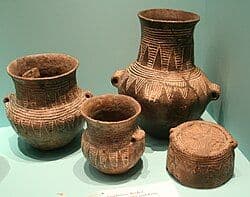
- It is called “Corded Ware” because pottery vessels were characteristically decorated using impressions made with cord or cord-like tools.
- It is associated with:
- Characteristic cord-impressed pottery
- Distinctive burial practices
- Stone battle axes
- Large-scale population movements and cultural change across Europe
- It was not a single homogeneous people or state. Rather, it comprised multiple regional communities sharing certain material and burial practices.
- Ancient-DNA research has established important genetic connections between Corded Ware populations and groups with ancestry associated with the Eurasian Steppe.
What does Corded Ware tell us about prehistoric society?
Changing social organisation:
- The emergence of individual graves with weapons and elaborate grave goods has been interpreted as evidence of increasing emphasis on:
- Individual identity
- Social differentiation
- Gender roles
- Warrior identities
- Personal status
- However, these interpretations remain subjects of archaeological debate.
Mobility and pastoralism
- Corded Ware communities are often associated with mobile livestock-based economies, although their subsistence was more diverse than the older image of exclusively mobile pastoralists suggests.
- Archaeological and isotope studies indicate combinations of:
- Animal husbandry
- Farming
- Hunting
- Fishing
- Gathering
Cultural transmission across Europe
- The widespread similarity of pottery, burial practices and weapon types indicates substantial exchange of ideas, practices and social norms across distant communities.
- Importantly, similar cultural practices do not necessarily mean that all these communities belonged to one ethnic group.
Conclusion:
The Corded Ware phenomenon represents one of the major transformations of prehistoric Europe, where changes in material culture, burial practices, population ancestry and social organisation occurred across a vast geographical area. Its study also demonstrates how archaeology, genetics and anthropology together are reshaping our understanding of prehistoric migrations and cultural change.