International Relations | GS III
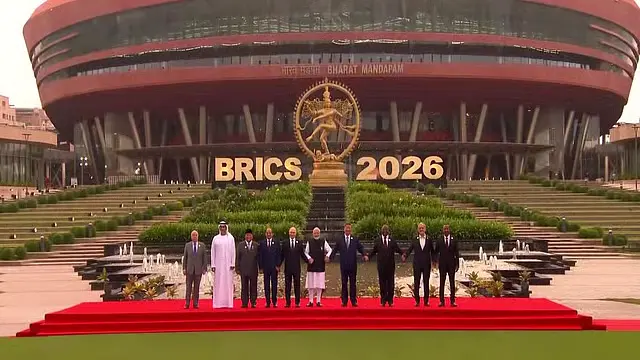
The 18th BRICS Summit was held in New Delhi on 12–13 September 2026 under India’s chairship, with the theme “Building for Resilience, Innovation, Cooperation and Sustainability.” The summit concluded with the adoption of the New Delhi Declaration by consensus.
What is BRICS?
- A grouping of major emerging economies and developing countries that seeks greater cooperation among its members and a stronger voice for the Global South in global governance.
- BRIC was initiated in 2006 by Brazil, Russia, India and China.
- South Africa joined in 2010, leading to the name BRICS.
- The grouping subsequently expanded to include Egypt, Ethiopia, Iran, the United Arab Emirates (UAE), Saudi Arabia and Indonesia.
- BRICS seeks cooperation in areas such as trade, finance, technology, health, energy, sustainable development and global governance reform.
- It is not a military alliance and does not function as a supranational organisation.
What is the significance of BRICS today?
- BRICS now has 11 members and represents nearly half of the world's population and around 40% of global GDP.
- It seeks greater representation for developing countries in institutions such as the United Nations (UN), International Monetary Fund (IMF), World Bank and World Trade Organisation (WTO).
- India's position is important here: BRICS should not be viewed simply as an anti-Western grouping; its purpose is to give the Global South a greater role in shaping global governance.
- This reflects India's approach of strategic autonomy and issue-based multilateralism.
What are the key takeaways of the 18th summit?
- Global order:
- Reforming global multilateral institutions
- IMF and WTO reforms
- BRICS expressed concern over unilateral tariff and non-tariff measures that distort global trade.
- Counter-terrorism cooperation:
- Response to major conflicts
- West Asia
- Russia–Ukraine
- Palestine: BRICS adopted a comparatively stronger position:
- Multipolar World:
- BRICS reaffirmed its commitment to multilateralism and multipolarity.
- It seeks greater representation of Emerging Markets and Developing Countries (EMDCs) in global decision-making.
- India emphasised that the Global South should move from being a “rule-taker” to a “rule-shaper.”
- At the same time, India stressed that BRICS is not against the West.
- Building resilient supply chains
- BRICS Logistics Supply Chain Cooperation Framework was proposed to make supply chains more reliable and resilient.
- Focus is particularly relevant amid disruptions caused by conflicts, pandemics and climate disasters.
- Insurance and risk resilience
- MSME finance
- Jaipur Consensus is the framework for an Invoice Discounting Mechanism among BRICS members.
- It aims to unlock working capital for export-oriented MSMEs.
- Food and agricultural security
- BRICS discussed operationalising a BRICS Grain Exchange and expanding it to other agricultural commodities.
- BRICS AGRIN → Agro-Inputs, Genetic Resources and Information Network.
- Global Forum on Farmers’ Rights in Seed Systems was launched.
- These initiatives seek to improve cooperation on agricultural inputs, genetic resources, food security and farmers’ interests.
- Early warning and disaster preparedness
- BRICS agreed on an Integrated Early Warning System for the prevention of and response to infectious diseases.
- Early Warning Data Integration Guidelines were prepared for disaster management.
- The objective is to improve early detection, information sharing and coordinated response.
- Technology and innovation
- Digital Public Infrastructure
- BRICS supported creation of a BRICS Digital Public Infrastructure Repository.
- It aims to facilitate the sharing and scaling of open-source digital public goods among member countries.
- This provides an avenue for India to share its experience with Digital Public Infrastructure (DPI).
- Space cooperation
- BRICS finalised amendments to include new member space agencies in the BRICS Remote Sensing Satellite Constellation (RSSC).
- Terms of Reference for a BRICS Space Council were drafted.
- This expands cooperation into earth observation and space governance.
- Digital agriculture
- MSME cooperation
- BRICS MSME Cooperation Portal was initiated.
- BRICS Urban Mobility Hub was established to facilitate sharing of best practices.
- These initiatives seek to improve access to knowledge, finance, technology and markets for smaller enterprises.
- Health:
- Mental health and healthy lifestyles
- Traditional medicine
- Labour and gig workers: BRICS CONNECT (Cooperation Network for Capacity Building, Employability, and New Skills and Technologies) focuses on:
- A dedicated sub-working group was proposed for an integrated early-warning system for infectious diseases.
- BRICS medical-product regulatory authorities also agreed to work towards a common Good Practice (GxP) white paper, consolidating regulatory best practices and technical approaches.
- BioDesign
- The BRICS BioDesign Programme was launched in partnership with the Andhra Pradesh MedTech Zone (AMTZ), Visakhapatnam.
- It aims to connect researchers, healthcare professionals, academic institutions and industry across BRICS.
- Focus: moving healthcare innovations from concept → prototype → deployable solution.
- It integrates clinical, design, engineering, prototyping and translational capabilities.
- Climate and sustainability
- Energy transition
- Critical minerals
- Landscape restoration
- Global climate finance
- Biodiversity: BRICS acknowledged India's initiative to lead the International Big Cats Alliance (IBCA) and encouraged cooperation among members for conservation of big-cat species.
- BRICS Digital Centre of Excellence → smart grids and energy storage.
- Centres of Excellence for Agro-Ecology and Regenerative Agriculture → combine traditional knowledge with modern science.
- Community-based climate adaptation principles seek to strengthen indigenous knowledge as a foundation for climate action.
How is BRICS strengthening Global South cooperation?
India used the summit to deepen engagement beyond the original BRICS membership.
Africa
- India held discussions with leaders from Ethiopia, South Africa, Uganda, Nigeria and Burundi.
- Focus areas included:
- Agriculture
- Healthcare
- Digital technology
- Capacity building
- Defence
- Investment
- Ethiopia highlighted the importance of digital public infrastructure and AI capacity for Africa.
Southeast Asia
India also engaged with Vietnam and Malaysia, strengthening its wider Global South and Act East engagement.
- Vietnam was described as an important pillar of India's Act East Policy.
- India–Malaysia cooperation covers trade, investment, defence, semiconductors, infrastructure, digital economy, energy and fintech.
UAE
- India–UAE ties were highlighted as an example of economic and strategic cooperation amid instability in West Asia.
- Areas include defence, space, nuclear energy, technology and innovation.
- The UAE's sovereign investment capacity provides opportunities for deeper investment in India.
What does the Summit reveal about BRICS’ geopolitical limitations?
Iran–UAE divide
- Iran and the UAE were on opposing sides of the West Asian conflict.
- Yet BRICS managed to adopt a joint declaration.
- The compromise involved generalised language calling for maximum restraint, without directly naming the parties responsible for the attacks.
Russia–Ukraine
- The declaration called for dialogue, consultation and diplomacy.
- It criticised unilateral sanctions not authorised by the UN Security Council.
- However, it avoided directly naming the Ukraine conflict.
Conclusion:
The 2026 BRICS Summit marked a shift from broad political declarations towards practical cooperation in health, technology, supply chains, finance and innovation. India’s larger objective was to make BRICS a platform where the Global South not only participates in global governance but helps shape its rules.